An agentic knowledge base that answers questions with citations.
Kibi
RoleSolo founder — design, engineering, product
Timeline2026
StackNext.js, TypeScript, Supabase, pgvector, Claude
The problem
Notes, conversations, and documents pile up faster than anyone reorganizes them. The knowledge is in there somewhere — the retrieval is the part that never gets built.
What I built
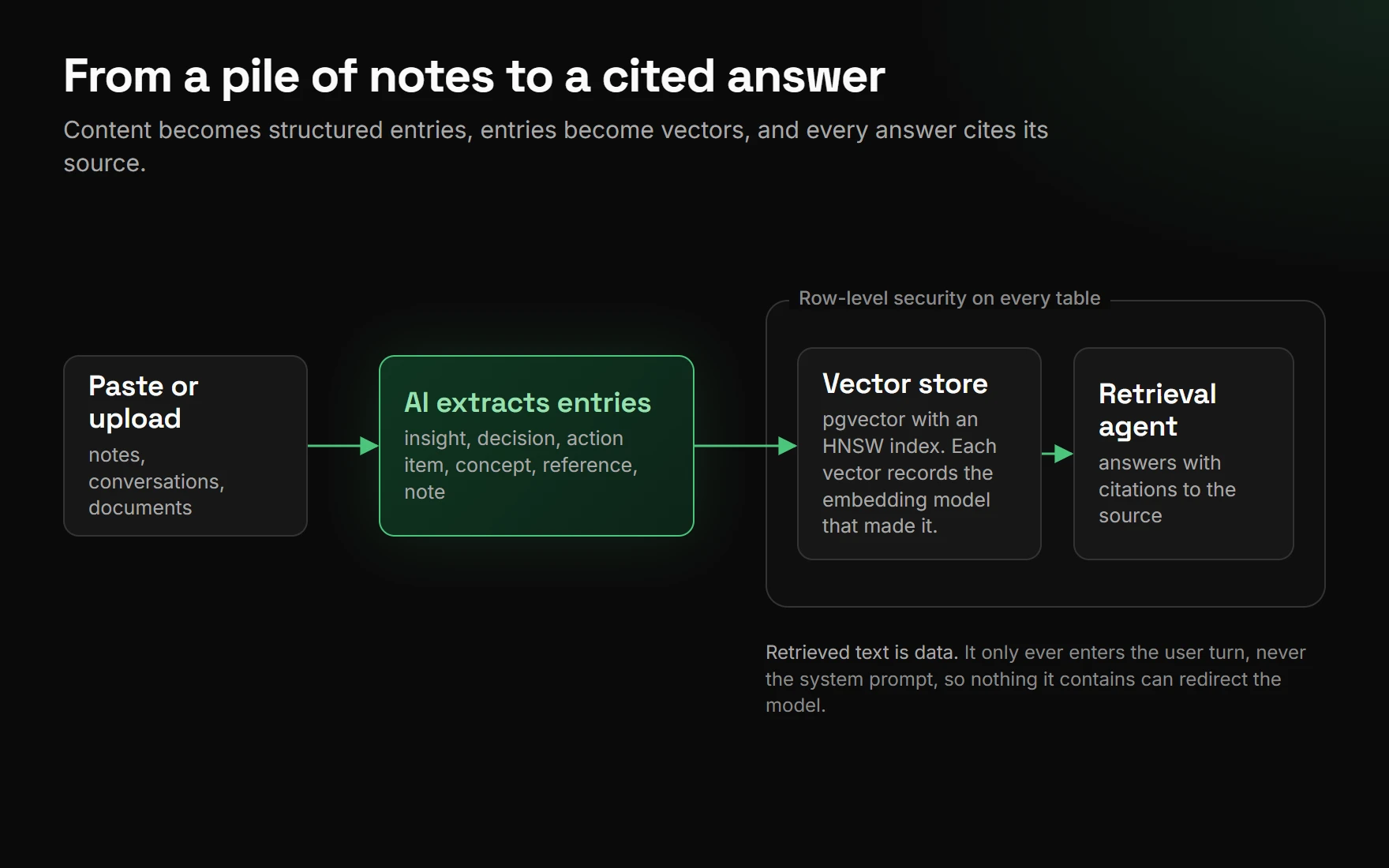
Kibi is an agentic knowledge base: paste or upload content, an AI extracts structured entries — insight, decision, action item, concept, reference, note — and a retrieval agent answers questions against them with citations back to the source.
- Retrieval is a real pipeline, not a keyword search. pgvector with an HNSW index; every stored vector records which embedding model produced it, so the model can be swapped later without breaking old data.
- Prompt injection is resisted structurally. Retrieved content is data, and only ever enters the user turn — never the system prompt. The model can't be redirected by something it retrieved.
- Row-level security on every table. Retrieval can't leak across accounts even if application code has a bug.
- A real bug, root-caused properly. Magic-link sign-in was silently failing for some users. The cause turned out to be a mail client's link-prescanner opening (and burning) the single-use token before the person ever clicked it — found by reading the actual auth logs, not by guessing.
Where it stands
Phase 1, built for a single user.